Creating the Ideal Study Timetable for Students: A Step-by-Step Guide to Success
posted on May 04, 2026
Looking for the best time table for study? This step-by-step guide helps students build a realistic, effective study timetable.
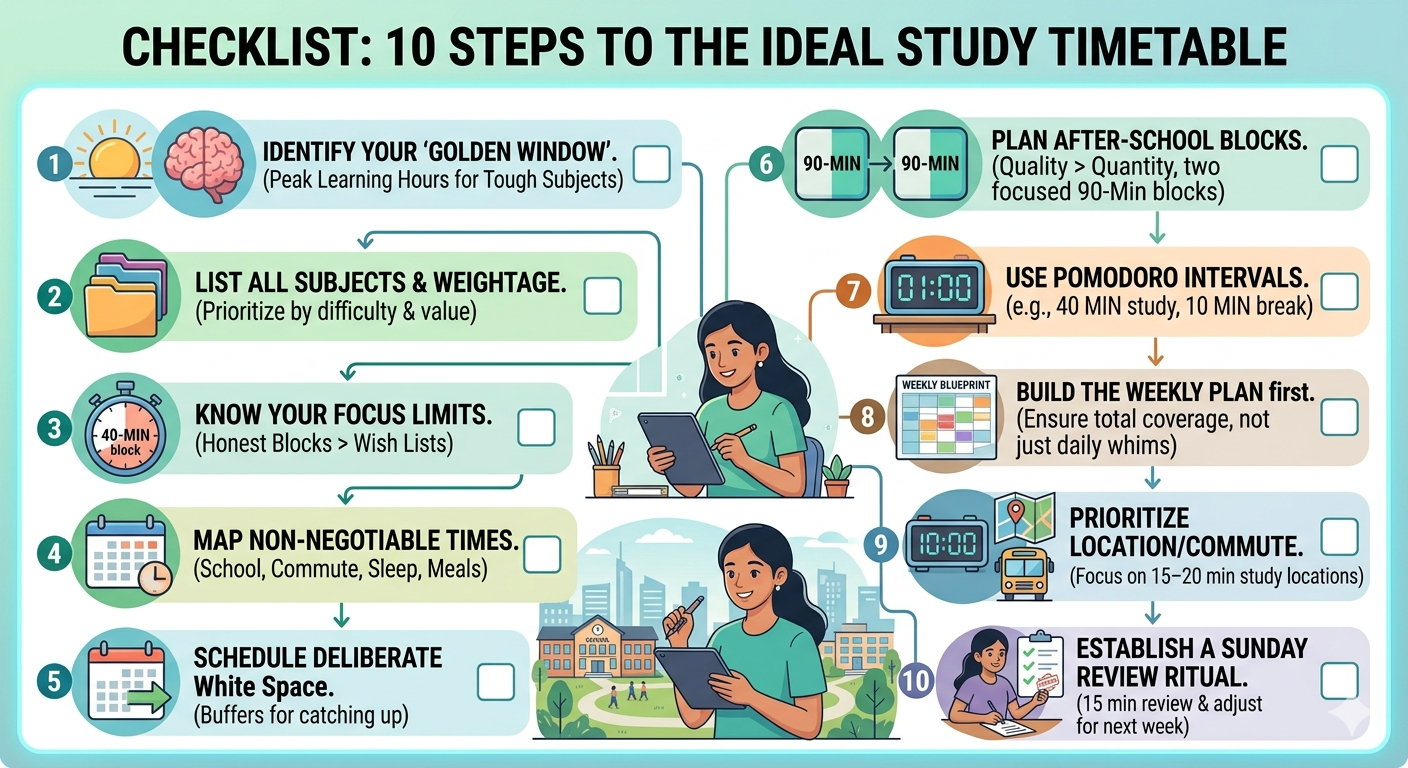
Introduction: Why Most Students Study Hard But Still Fall Behind
Here's something every parent and student knows but rarely talks about: working hard is not the same as studying smart.
Countless students spend hours at their desks every evening — but without a structured study timetable, those hours scatter. One subject gets too much time. Another is left for the last minute. Sleep gets sacrificed. And come exam time, panic sets in.
The solution is not more study hours. It is better ones.
A well-designed time table for study is one of the most underrated tools in a student's academic toolkit. It brings predictability, removes decision fatigue, ensures every subject gets adequate attention, and — perhaps most importantly — creates space for rest, play, and family time too.
This guide walks through everything: why a student time table matters, how to build one from scratch, what the best time table for study after school actually looks like, and how to stick to it when motivation dips. Whether you're a student building your own schedule or a parent helping your child create one, this is the guide you've been looking for.
What Is a Study Timetable and Why Does It Matter?
A study timetable is a structured, time-bound plan that tells a student what subject to study, for how long, and when — across a day, a week, or an exam preparation period.
It is different from simply "deciding to study at 5 PM." A proper time table for study allocates specific slots to specific subjects, accounts for breaks, and balances difficulty levels across the day.
The Science Behind Scheduled Study
Research in educational psychology consistently shows that students who follow a study schedule:
- Retain information more effectively through spaced repetition
- Experience less pre-exam anxiety because content is covered progressively
- Develop stronger metacognitive skills (knowing what they know and what they don't)
- Build disciplined habits that carry forward into higher education and careers
At Queen's Valley School, the best CBSE school in Delhi — where holistic development is at the core of the school's philosophy — students are actively guided to develop structured study habits from their primary years onwards. The school's approach recognizes that academic excellence is not just about what happens in the classroom; it is equally about how students manage their learning time at home.
Before You Build the Timetable: Know These 5 Things First
Jumping straight into making a timetable without understanding a student's unique situation is why most study schedules get abandoned in two weeks. Before building one, consider these five foundations:
1. Identify Your Peak Learning Hours
Every student has a "golden window" — a time of day when focus is sharpest and energy is high. For most students, this is either the early morning (before school) or the early evening (post-school, after a short break). Difficult subjects like Mathematics and Science should be placed in this window.
2. List All Subjects and Their Weightage
Write down every subject being studied. Then rank them by difficulty and by exam weightage. High-difficulty, high-weightage subjects deserve more weekly study hours than low-difficulty elective subjects.
3. Know How Long You Can Actually Concentrate
The average student can maintain focused attention for 25–45 minutes before needing a break. A timetable built on 3-hour uninterrupted blocks is not a timetable — it's a wish list. Honest time blocks are far more effective.
4. Account for School Hours, Commute, and Fixed Activities
A time table for study must work around the student's actual day — school hours, travel time, meals, extracurricular activities, and family routines. Ignoring these realities is why most timetables collapse within days.
5. Leave Deliberate White Space
Every good time table for students includes buffer slots — unscheduled time for catching up on missed sessions, extended review of a difficult topic, or simply resting. A timetable with no slack is one unexpected event away from total derailment.
Step-by-Step Guide to Creating a Study Timetable
Step 1: Map Out Your Fixed Time Blocks
Start by blocking out everything that is non-negotiable — school hours, sleep time, meals, commute, and regular family commitments. What remains is your available study time.
Example Fixed Blocks (School Day):
|
Time Slot
|
Activity
|
|
6:30 AM – 7:30 AM
|
Morning routine + breakfast
|
|
7:30 AM – 2:30 PM
|
School
|
|
2:30 PM – 3:00 PM
|
Commute home
|
|
3:00 PM – 3:45 PM
|
Lunch + rest
|
|
7:30 PM – 9:00 PM
|
Dinner + family time
|
|
9:00 PM – 9:30 PM
|
Wind-down + sleep prep
|
|
9:30 PM onwards
|
Sleep
|
This leaves roughly 3–4 hours of study-available time on a school day: typically 3:45 PM – 7:30 PM, minus break slots.
Step 2: Identify Your Study Windows and Assign Subjects
Now map subjects to the available windows based on difficulty and personal energy levels.
General Rule of Thumb:
- High-focus subjects (Maths, Science, Social Studies): Assign to your peak energy window
- Moderate-focus subjects (English, Second Language, History): Assign to mid-energy slots
- Light revision or creative work (Art, reading, light review): Assign to low-energy slots
Step 3: Decide Study Block Duration + Break Intervals
The most effective study block structure for school students is the Pomodoro-style model:
|
Study Block Duration
|
Break Duration
|
Notes
|
|
25 minutes
|
5 minutes
|
Best for younger students (Classes 3–6)
|
|
40 minutes
|
10 minutes
|
Ideal for Classes 7–10
|
|
50 minutes
|
15 minutes
|
Suitable for Classes 11–12
|
Never schedule more than two consecutive study blocks on the same subject. The brain needs variety to stay engaged.
Step 4: Build the Weekly Timetable (Not Just Daily)
A daily timetable is useful, but a weekly time table for study is more powerful because it ensures all subjects are covered across the week — not just the ones a student feels like doing on a given day.
Sample Weekly Study Timetable for Students (Classes 6–8):
|
Day
|
4:00–4:45 PM
|
4:55–5:40 PM
|
5:50–6:20 PM
|
6:30–7:15 PM
|
|
Monday
|
Mathematics
|
Science
|
Break / Snack
|
English
|
|
Tuesday
|
Social Studies
|
Mathematics
|
Break / Snack
|
Hindi
|
|
Wednesday
|
Science
|
English
|
Break / Snack
|
Revision (any)
|
|
Thursday
|
Mathematics
|
Social Studies
|
Break / Snack
|
Science
|
|
Friday
|
English
|
Hindi
|
Break / Snack
|
Light Reading
|
|
Saturday
|
Weak Subject Focus
|
Project / Assignment
|
Break
|
Revision
|
|
Sunday
|
Catch-up / Rest
|
—
|
—
|
Light review only
|
Step 5: Build the Daily Timetable Around the Weekly Plan
Once the weekly structure is clear, the daily time table for students becomes easier to follow because it is not a fresh decision every morning — it is already decided.
Sample Daily Study Time Table (Monday — School Day):
|
Time
|
Activity
|
|
3:45 PM
|
Arrive home, change, have water
|
|
4:00 PM – 4:45 PM
|
Mathematics (focused block)
|
|
4:45 PM – 4:55 PM
|
Short break (stretch, water, no screens)
|
|
4:55 PM – 5:40 PM
|
Science
|
|
5:40 PM – 5:50 PM
|
Snack break
|
|
5:50 PM – 6:20 PM
|
Free time / light activity
|
|
6:30 PM – 7:15 PM
|
English or Hindi
|
|
7:15 PM – 7:30 PM
|
Review what was studied (5-minute recall)
|
|
7:30 PM onwards
|
Dinner, family time, wind-down
|
Step 6: Add a Weekly Review Ritual
Every Sunday, spend 15 minutes reviewing the week. Ask:
- Which subjects got enough time? Which didn't?
- Was the timetable realistic, or were sessions frequently skipped?
- What needs more time next week?
Adjust the following week's timetable based on these answers. A study timetable is a living document — it should evolve as the student's needs change.
Best Time Table for Study After School: Key Principles
The post-school hours are the most valuable — and the most wasted — part of a student's day. Here's what the best time table for study after school consistently looks like:
The Golden 90-Minute Rule
The most productive students don't study for 4 hours straight after school. They study in two focused 90-minute blocks (with a break in between), then stop. Quality beats quantity every time.
The After-School Study Structure That Works
|
Phase
|
Time
|
Activity
|
|
Decompression
|
30–45 min
|
Rest, snack, disconnect from school-mode
|
|
Block 1
|
60–90 min
|
Hardest subject of the day
|
|
Break
|
15–20 min
|
Walk, snack, non-screen activity
|
|
Block 2
|
45–60 min
|
Second subject or assignments/projects
|
|
Wind-down
|
20 min
|
Light review, recap of the day's learning
|
What to Avoid in the Post-School Window
- Starting study within 15 minutes of arriving home (the brain needs to decompress)
- Checking social media "for 5 minutes" before studying (it doesn't stay 5 minutes)
- Studying lying on the bed (signals rest, not work, to the brain)
- Skipping the break between blocks (fatigue compounds without breaks)
Timetable for Study for a Student at Home
For students managing home-based study — whether during exam preparation, holidays, or hybrid learning — the structure needs to be more deliberate because the home environment offers more distractions and fewer natural time cues.
Common Mistakes to Avoid When Making a Study Timetable
Even well-intentioned students build timetables that fail. Here's why — and how to avoid it:
|
Mistake
|
Why It Fails
|
What to Do Instead
|
|
Overpacking every slot
|
No breathing room; one disruption breaks the whole day
|
Add 1 buffer slot per day
|
|
Studying the "favourite" subject daily
|
Neglects weak subjects
|
Rotate based on need, not comfort
|
|
No breaks built in
|
Mental fatigue kills retention after 40 mins
|
Schedule breaks as non-negotiables
|
|
Making the timetable too rigid
|
Life happens; rigid plans collapse
|
Build in a catch-up slot weekly
|
|
Never reviewing the timetable
|
Child grows, subjects change, the schedule should too
|
Weekly 15-minute review ritual
|
|
Treating weekends as holidays
|
Inconsistency breaks momentum
|
Light study on Sundays — 1–2 hours max
|
How Schools Support Good Study Habits
A timetable works best when the school and home are aligned. The best schools don't just teach content — they teach students how to learn.
At Queen's Valley School in Dwarka, time management and self-regulated learning are embedded into the school's academic structure. Students are encouraged to maintain subject-wise academic planners, and the school's faculty development programme ensures teachers are equipped to guide students on effective home study habits — not just classroom performance.
This kind of institutional support makes a measurable difference: when a student's school and home study habits reinforce each other, academic outcomes improve significantly.
Age-Wise Study Timetable Recommendations
Different age groups have very different attention spans, energy levels, and academic loads. The ideal time table for study is not one-size-fits-all.
Study Time Recommendations by Age Group
|
Class Group
|
Age
|
Daily Study Time (Excl. School)
|
Max Continuous Block
|
|
Classes 1–3
|
6–8 years
|
30–45 minutes
|
15–20 minutes
|
|
Classes 4–5
|
9–10 years
|
1–1.5 hours
|
25–30 minutes
|
|
Classes 6–8
|
11–13 years
|
2–3 hours
|
40–45 minutes
|
|
Classes 9–10
|
14–15 years
|
3–4 hours
|
50 minutes
|
|
Classes 11–12
|
16–17 years
|
4–6 hours
|
60 minutes
|
Critical note for parents: More time at the desk does not mean more learning. A Class 4 child studying for 3 hours is almost certainly doing unproductive seat-warming after the first 90 minutes. Trust the age-appropriate limits above.
The Role of Sleep and Physical Activity in Academic Performance
No study timetable is complete without accounting for sleep and physical activity. These are not interruptions to learning — they are enablers of it.
Sleep deprivation reduces memory consolidation, impairs attention, and increases anxiety — three things that directly undermine academic performance. A student who sleeps well and studies for 3 hours will consistently outperform one who sleeps poorly and studies for 5.
Physical Activity
At least 45–60 minutes of physical activity per day is not just good for health — it is good for learning. Exercise increases blood flow to the prefrontal cortex (the area responsible for attention and decision-making) and elevates mood-stabilizing neurotransmitters that make sustained study easier.
Schools like Queen's Valley School, which maintain dedicated sports and HPE (Health and Physical Education) programmes, understand this connection well. Physical activity is not a luxury in a student's schedule — it is a requirement.
Exam Preparation: How to Modify the Timetable
When exams are 4–6 weeks away, the regular study timetable needs to be adjusted — not completely rebuilt.
Exam Timetable Modifications
|
Change
|
How to Implement
|
|
Prioritize by exam date
|
Closest exam gets the most time in the week
|
|
Increase daily study time
|
Add one extra 45-minute block per day
|
|
Introduce mock tests
|
Replace one revision block with a timed practice test
|
|
Add "panic-proof" buffer days
|
2 days before each exam: review only, no new topics
|
|
Reduce non-academic screen time
|
Replace 1 hour of entertainment with productive revision
|
10 Quick Tips for Sticking to Your Study Timetable
A timetable is only as good as the habit it builds. Here's how to make it stick:
- Start with a shorter, doable timetable — build up over weeks, not days
- Keep the timetable visible — pin it at the study desk, not stored in a phone
- Begin with the subject you enjoy least — don't save the worst for last
- Use a timer — it creates urgency and makes breaks feel earned
- Track completion — tick off each completed session (small dopamine reward)
- Tell someone your timetable — accountability improves follow-through
- Don't try to compensate a missed day with double sessions — just continue
- Revisit the timetable monthly — adjust for new chapters, upcoming tests, school events
- Separate "study" and "phone" physically — keep the phone in another room during study blocks
- Celebrate streaks — 7 days of following the timetable deserves a genuine reward
FAQs About Study Timetables for Students
Q1. What is the best time table for study for students?
The best time table for study is one that matches the student's actual daily schedule, accounts for their peak concentration hours, distributes all subjects across the week, includes regular breaks, and is reviewed weekly. There is no universal "best" timetable — a good one is personalized, realistic, and flexible enough to survive an unexpected bad day.
Q2. How many hours should a student study per day?
This depends on age and class level. A rough guide:
- Classes 1–3: 30–45 minutes per day
- Classes 4–5: 1–1.5 hours per day
- Classes 6–8: 2–3 hours per day
- Classes 9–10: 3–4 hours per day
- Classes 11–12: 4–6 hours per day
Quality and focus matter more than raw hours. A distracted 4-hour session is less effective than a focused 2-hour one.
Q3. What is the best time to study — morning or evening?
Research suggests early morning (5–8 AM) is optimal for deep cognitive work because the brain is rested and cortisol levels are naturally higher, aiding alertness. However, not every student is a morning person. For most school-going students, the best practical window is the early evening (4–7 PM), after school and a brief rest period. The most important factor is consistency — studying at the same time each day builds a neurological habit.
Q4. How do I make a timetable for study for a student at home?
For a student studying at home (during holidays, exam prep, or otherwise):
- Divide the day into morning, midday, and evening study blocks
- Assign the hardest subjects to the morning block
- Build in a mandatory midday rest (1.5–2 hours)
- Use a fixed study spot and set start-time alarms
- Include at least 45–60 minutes of outdoor/physical activity
- Keep evenings lighter — review and reading rather than new content
Q5. How do I help my child stick to a study timetable?
- Make the child part of building the timetable (ownership increases compliance)
- Keep it visible on paper at the desk
- Set consistent start-time reminders
- Create a distraction-free study environment during the scheduled slots
- Avoid criticism when the timetable slips — adjust and restart
- Acknowledge when the timetable is followed consistently (positive reinforcement works)
Q6. Should a study timetable include weekends?
Yes — but lightly. Completely dropping all study on weekends breaks momentum and often creates Sunday-night panic. A healthy weekend timetable includes 1–2 hours of light revision or project work on Saturday, and a maximum of 1 hour of light reading or review on Sunday. Sundays should largely be reserved for rest, family time, and recharging.
Q7. How often should a student timetable be changed?
A weekly micro-review (15 minutes every Sunday) to adjust time allocations is ideal. A full timetable overhaul should happen at the start of each new term, when exams approach (4–6 weeks out), or when a subject consistently gets neglected or overwhelms the student.
Q8. What is a good study timetable for Class 10 students?
Class 10 students need 3.5–4.5 hours of daily study outside school. A strong timetable for a Class 10 student allocates:
- 1.5 hours to Mathematics (daily)
- 1 hour to Science (daily)
- 45 minutes to Social Studies (5 days a week)
- 45 minutes to Languages (alternating English and Hindi/Second Language)
- Weekly mock tests replacing one revision session every Saturday
Exam-season modifications (from January onwards for CBSE) should intensify revision and introduce timed practice papers at least twice a week.
Q9. Is it okay for a student to follow a flexible timetable?
A degree of flexibility is healthy — an immovable timetable that cannot accommodate an unwell day or a school event is counterproductive. However, flexibility should apply to when sessions happen, not whether they happen. The goal is to ensure every subject receives adequate time across the week, even if the day-level schedule shifts slightly.
Q10. Can a study timetable help with exam anxiety?
Yes — significantly. Exam anxiety is largely fuelled by the fear of being underprepared. A consistent study timetable, followed over weeks and months, ensures content is covered progressively. By the time exams arrive, a student who has followed a proper time table for study is not cramming — they are reviewing. This dramatically reduces anxiety and builds the quiet confidence that comes from genuine preparation.
Conclusion: The Timetable Is the Foundation, Not the Ceiling
A study timetable does not guarantee success. What it does is remove the obstacles between effort and outcome.
When a student knows exactly what to study, when to study it, and how long to spend on it — the energy that would otherwise go into decision-making, guilt, and avoidance goes into actual learning instead.
Start simple. One week at a time. Adjust as you go. And remember: the goal is not a perfect timetable — it is a consistent one.
Schools like Queen's Valley School , the best CBSE school in New Delhi recognize that the habits a student builds outside the classroom matter just as much as the lessons inside it. A student who learns to manage their time well in Class 6 has a skill that will serve them in Class 12, in college, and across every professional challenge that follows.
Build the timetable. Follow it imperfectly. Refine it weekly. That is the real step-by-step guide to success.