The 4 Pillars of Education
posted on May 01, 2026
Explore the 4 pillars of education - learning to know, do, live together & be and discover the purpose of education for holistic growth."
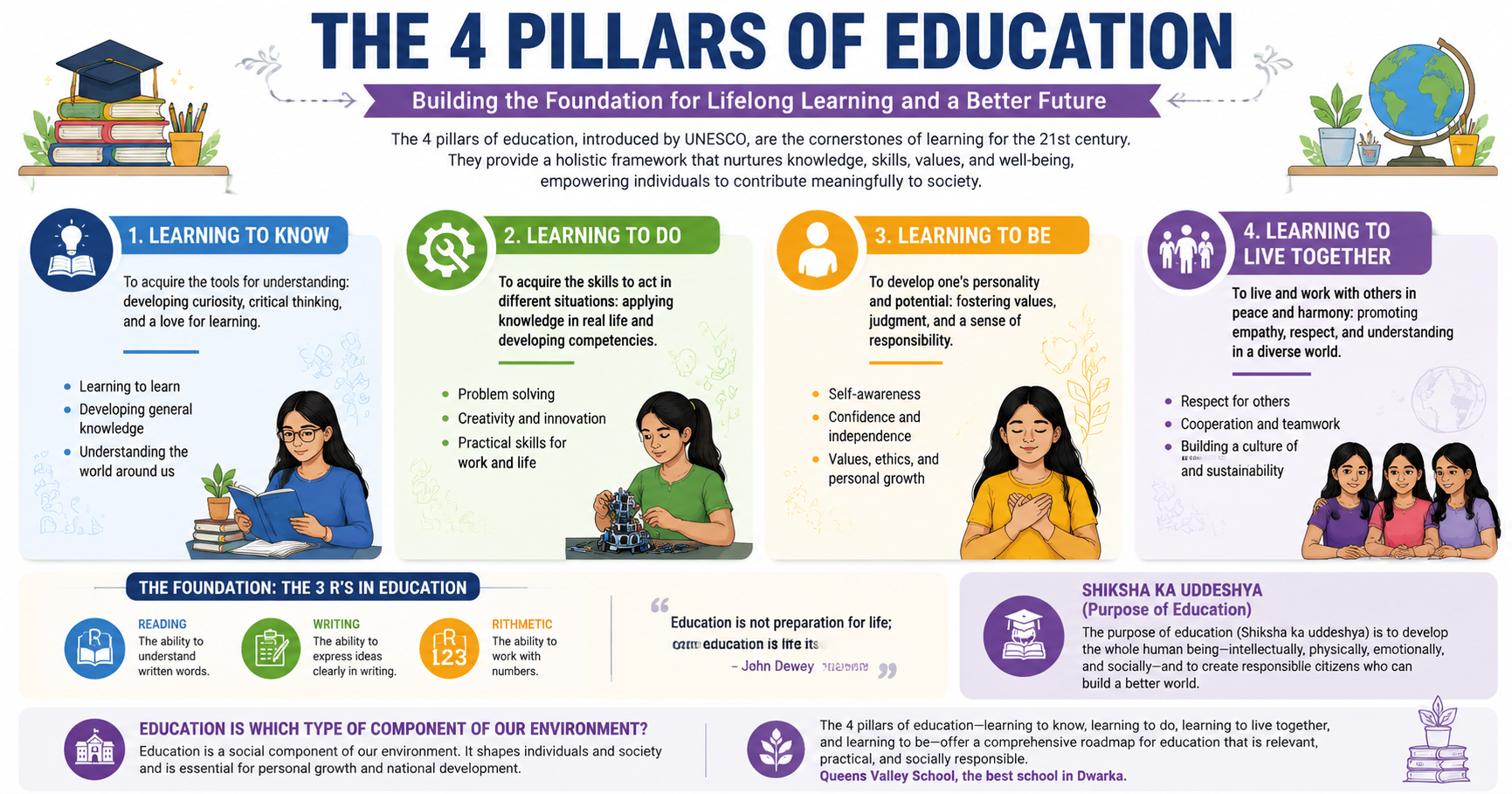
Education is often described as the cornerstone of personal growth, social development, and the progress of civilization. For centuries, scholars, policymakers, and educators have debated the purpose of education or shiksha ka uddeshya—why we educate children, youth, and adults, and what outcomes society expects from the learning process. Traditional education focused primarily on literacy, numeracy, and knowledge acquisition. Today, however, a more holistic approach is recognized worldwide, notably through the UNESCO four pillars of education, which outline a comprehensive vision of what learning should encompass.
The 4 pillars of education provide a framework to cultivate intellectual, practical, social, and personal development, forming the foundation for lifelong learning. Understanding these pillars is crucial not only for educators and students but also for parents, policymakers, and society at large. At Queens Valley School, the best school in Dwarka, these pillars are actively embraced, ensuring students develop holistically. This article delves deep into the four pillars of learning, their significance, practical applications, and their integration into modern educational systems.
What Are the 4 Pillars of Education?
The UNESCO four pillars of education were formally presented in 1996 in the report Learning: The Treasure Within, emphasizing that education should foster not only cognitive skills but also social, emotional, and practical competencies. The four pillars of learning are:
- Learning to Know
- Learning to Do
- Learning to Live Together
- Learning to Be
Each pillar represents a critical dimension of human development, collectively guiding learners toward holistic growth.
1. Learning to Know
The first pillar, learning to know, is primarily cognitive. It is about acquiring knowledge, understanding concepts, and developing intellectual skills. This pillar encourages curiosity and critical thinking, moving beyond rote memorization to a deep understanding of the world.
Key Aspects of Learning to Know:
- Knowledge Acquisition: Students learn essential facts, concepts, and theories across subjects such as science, mathematics, literature, and social studies.
- Critical Thinking: Learners are encouraged to question, analyze, and evaluate information, ensuring that knowledge is meaningful and applicable.
- Lifelong Learning: This pillar fosters a mindset of continuous inquiry and intellectual growth.
Practical Examples:
- Research projects, reading assignments, and debate sessions that encourage exploration of topics in depth.
- Using educational technology, like interactive e-learning platforms, to supplement classroom knowledge.
- Encouraging students to explore the natural world, conduct experiments, and understand cause-effect relationships.
Connection to Other Concepts:
The 3 R’s in education—Reading, Writing, and Arithmetic—are foundational components integrated into this pillar. While reading enhances knowledge acquisition, writing develops comprehension and articulation, and arithmetic hones problem-solving skills. In modern education, learning to know forms the intellectual base on which practical, social, and personal competencies are built.
2. Learning to Do
The second pillar, learning to do, emphasizes the application of knowledge through skills development. It ensures that education is not merely theoretical but also practical, enabling learners to contribute meaningfully to society.
Objectives of Learning to Do:
- Skill Development: Students acquire vocational, technical, and life skills that prepare them for employment and societal contribution.
- Problem-Solving Abilities: This pillar encourages analytical and practical problem-solving, from simple everyday challenges to complex societal issues.
- Innovation and Creativity: Students learn to adapt, innovate, and implement solutions in real-world scenarios.
Examples in Education:
- Laboratory experiments, workshops, and skill-based courses in schools and universities.
- Objectives of health education programs where learners practice hygiene, nutrition, and preventive health measures.
- Project-based learning initiatives that involve community engagement, entrepreneurship, or environmental conservation.
Why It Matters:
Learning to do ensures that knowledge is actionable. For instance, a student may learn to know about sustainable farming techniques, but through learning to do, they can implement these techniques in local agricultural projects, thereby applying theory in practice. UNESCO emphasizes that this pillar prepares students to be competent professionals and responsible citizens.
3. Learning to Live Together
Education is not only about personal development but also about social harmony. The third pillar, learning to live together, addresses social, ethical, and interpersonal skills. It emphasizes empathy, tolerance, and collaboration, helping students navigate the complexities of diverse societies.
Key Features:
- Social Skills: Teaching effective communication, teamwork, and conflict resolution.
- Cultural Awareness: Encouraging appreciation of different traditions, beliefs, and perspectives.
- Global Citizenship: Developing the ability to cooperate with others in local, national, and global contexts.
Practical Examples:
- Group projects and cooperative learning in classrooms.
- Cultural exchange programs or school initiatives that celebrate diversity.
- Community service activities that cultivate empathy and social responsibility.
Importance:
By integrating learning to live together into education, schools promote peace, understanding, and collaboration. This pillar is essential in addressing modern challenges such as social inequality, communal tensions, and global conflicts. Students not only acquire knowledge and skills but also develop the emotional intelligence required to thrive in diverse communities.
4. Learning to Be
The fourth pillar, learning to be, emphasizes personal development, self-awareness, and moral growth. It addresses the holistic development of a learner, nurturing creativity, values, and individuality.
Components:
- Self-Development: Building confidence, resilience, and personal discipline.
- Moral and Ethical Growth: Instilling values, integrity, and responsibility.
- Emotional Intelligence: Enhancing awareness of personal emotions and those of others.
Practical Applications:
- Encouraging participation in arts, music, sports, and mindfulness activities.
- Reflection exercises, mentorship programs, and leadership initiatives.
- Activities that allow self-expression and creativity, such as writing, painting, or performing arts.
Significance:
The purpose of education is not only to create skilled professionals but also well-rounded individuals. By focusing on learning to be, education empowers learners to explore their potential, develop self-identity, and contribute positively to society.
Integrating the 4 Pillars of Learning in Modern Education
Modern education systems are increasingly adopting the four pillars of learning to ensure holistic development. This integration has implications for curriculum design, teaching methodologies, and assessment strategies.
Curriculum Implications:
- Balancing academic subjects with vocational training and life skills.
- Including arts, culture, ethics, and mindfulness programs to nurture personal growth.
- Integrating collaborative and experiential learning activities to strengthen social skills.
Teaching Methodologies:
- Student-centered learning approaches, including inquiry-based and project-based learning.
- Use of technology to enhance learning to know while providing platforms for learning to do.
- Collaborative group activities and peer-learning to promote learning to live together.
Assessment Strategies:
- Evaluating not only knowledge acquisition but also practical application and social competencies.
- Portfolios, self-assessments, and reflective journals that capture growth in learning to be.
- Community-based projects and experiential learning assessments.
Visualizing the Four Pillars
An education diagram often represents the pillars as interdependent supports for learning. Each pillar strengthens the others, and neglecting one can compromise overall development. Visual representations help educators, students, and policymakers understand the holistic approach to learning.
Example Diagram Concept:
This visualization demonstrates that the pillars are interconnected, reinforcing one another to ensure comprehensive development. Education is a component of our environment that shapes individuals’ abilities, attitudes, and behaviors, influencing society as a whole.
Historical Context of the 4 Pillars
The UNESCO four pillars of education emerged in response to global educational challenges. In the 20th century, education often focused narrowly on literacy and numeracy. UNESCO recognized the need for an inclusive framework that promotes personal, social, and practical competencies alongside intellectual growth.
Globally, schools have adapted these pillars in various ways:
- Scandinavian countries emphasize experiential learning and social equality.
- India incorporates moral education, vocational training, and extracurricular activities to address shiksha ka uddeshya.
- International Baccalaureate (IB) programs integrate personal development and global citizenship into academic curricula.
The 3 R’s and the Four Pillars of Education
The 3 R’s in education—Reading, Writing, and Arithmetic—remain foundational but are no longer sufficient alone. They form a core component of learning to know, but modern education integrates them into a broader framework:
- Reading: Enhances comprehension and critical thinking.
- Writing: Promotes reflection, communication, and problem-solving.
- Arithmetic: Develops logical reasoning and analytical skills.
By combining the 3 R’s with learning to do, learning to live together, and learning to be, educators ensure learners are equipped to succeed academically, professionally, and socially.
The Purpose of Education Today
The purpose of education is multi-dimensional:
- Cognitive Development – Developing knowledge, reasoning, and intellectual curiosity.
- Skill Acquisition – Preparing learners for employment, entrepreneurship, and practical challenges.
- Social Responsibility – Encouraging empathy, collaboration, and cultural awareness.
- Personal Growth – Building self-confidence, creativity, and ethical judgment.
By following the four pillars of learning, education fulfills its broad mandate, ensuring learners are well-prepared for the complexities of the modern world.
Conclusion
The 4 pillars of education—learning to know, learning to do, learning to live together, and learning to be—offer a comprehensive roadmap for education that is relevant, practical, and socially responsible. They provide a framework to fulfill the purpose of education or shiksha ka uddeshya, fostering intellectual, practical, social, and personal development. At Queens Valley School, the best school in West Delhi, these pillars are actively integrated into the curriculum, ensuring students grow holistically.
Education is not just about gaining knowledge but about shaping individuals capable of critical thinking, ethical decision-making, and constructive engagement with society. By adopting these pillars, schools, policymakers, and educators can nurture a generation that is not only skilled and knowledgeable but also empathetic, creative, and resilient.
The UNESCO four pillars of education remain a timeless guide to creating meaningful, well-rounded education systems that prepare learners for a dynamic and interconnected world. Integrating these pillars into curricula, teaching methods, and assessment strategies ensures that education serves its ultimate purpose: building informed, competent, and compassionate citizens.