What is Group Discussion?
posted on May 20, 2026
What is group discussion? Learn the definition, types of group discussion, process, methods, and importance with expert tips to excel in any GD round.
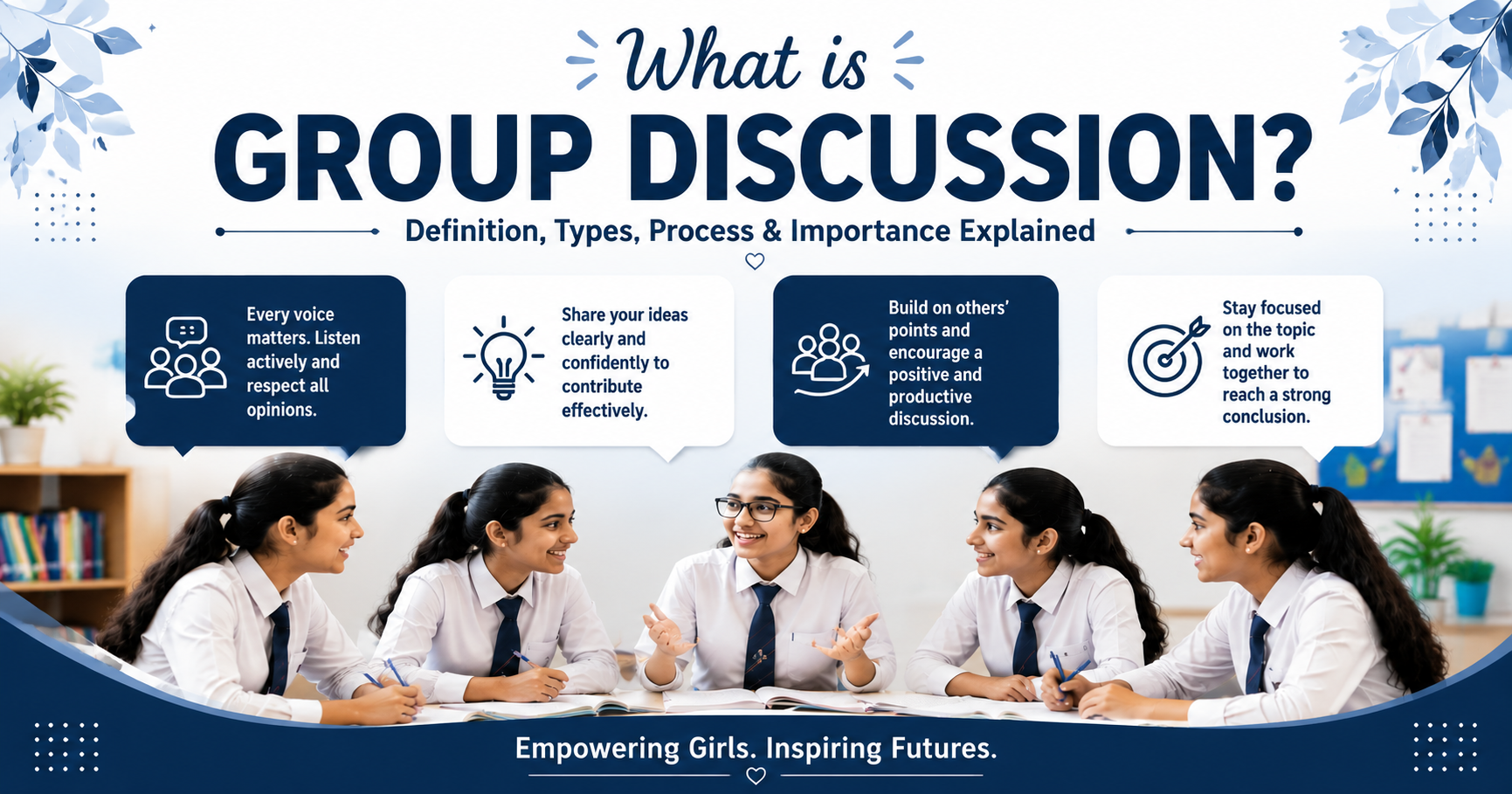
Group discussion is one of the most widely used communication and evaluation tools across academic institutions, corporate boardrooms, and competitive selection processes. Whether you are a student preparing for a campus placement, a professional navigating team meetings, or an educator designing collaborative learning activities, understanding what group discussion means — and how it works — is foundational knowledge. At Queen's Valley School, the best CBSE school in Delhi, students are encouraged to engage in group discussions to enhance critical thinking, collaboration, and communication skills.
This comprehensive guide covers the group discussion definition, its types, process, methods, and importance, along with expert tips to help you perform your best.
What Do You Mean by Group Discussion?
So, what is group discussion? In its simplest form, group discussion (GD) is a structured communication method where a group of individuals — typically 6 to 15 people — exchange their ideas, opinions, and perspectives on a given topic, problem, or situation. The objective is to arrive at a collective understanding, explore multiple viewpoints, or assess participants on their communication, critical thinking, and leadership abilities.
Formal Group Discussion Definition
Group discussion definition: A group discussion is a goal-oriented, interactive communication process in which participants collaboratively analyze, debate, and deliberate on a common topic within a set timeframe, guided by certain norms and facilitated by a moderator or group leader.
The phrase "GD meaning" extends beyond just talking in a group. It implies purposeful dialogue where every participant contributes meaningfully, listens actively, and responds constructively. In academic and corporate contexts, group discussion is both a learning tool and a selection instrument.
What is the Definition of Group Discussion in Communication?
In the context of communication studies, group discussion in communication refers to a dynamic exchange process where verbal and non-verbal signals, listening, argumentation, and interpersonal skills all interact simultaneously. It is a form of small group communication that differs from a debate (which is adversarial) and a lecture (which is one-directional).
Group discussion happens between individuals who share a common purpose — whether that is solving a problem, evaluating a policy, learning a concept, or being assessed for a role. According to communication theorists, a GD represents a transactional communication model where all participants are simultaneously senders and receivers of information.
Key elements that define group discussion in communication include:
- Mutual participation — all members are expected to contribute
- Topic centrality — the conversation stays focused on a defined subject
- Turn-taking norms — structured or unstructured, participants alternate speaking
- Active listening — participants respond to each other, not just present monologues
- Collective reasoning — the group builds understanding together rather than individually
Group Discussion Meaning in Academic and Corporate Contexts
The group discussion meaning shifts subtly depending on context.
In educational settings, GDs are used as a teaching method to encourage critical thinking, peer learning, and articulation of ideas. Students are assigned topics — ranging from current affairs and ethical dilemmas to case studies — and asked to discuss them in groups.
In corporate recruitment and MBA admissions, GD is a shortlisting tool. Recruiters observe how candidates think on their feet, whether they respect opposing views, how clearly they communicate, and whether they can lead or contribute to consensus-building under pressure.
In government and policy forums, group discussion serves as a deliberative method for collective decision-making, bringing diverse stakeholders to the table.
Regardless of context, the core group discussion meaning remains consistent: it is a structured, purposeful, multi-person conversation aimed at exploration and understanding.
Explain Group Discussion: How Does It Work?
To fully explain group discussion, it helps to understand its mechanics. A typical GD session involves:
- A topic or case — given to participants in advance or on the spot
- Preparation time — usually 2–5 minutes to organize thoughts
- The discussion — lasting anywhere from 10 to 25 minutes
- Evaluation or debrief — a moderator assesses performance or the group summarises findings
Group discussions can be moderated (a facilitator guides the flow) or unmoderated (the group self-organises). In competitive scenarios like MBA GDs or job selections, a panel of evaluators observes the discussion without intervening, assessing each participant on predefined parameters.
Process of Group Discussion: Step-by-Step Breakdown
Understanding the process of group discussion is critical for both participants and facilitators. Here is a detailed walkthrough:
Step 1: Topic Introduction
The moderator or evaluator announces the topic. This may be a factual topic ("Impact of AI on employment"), a controversial statement ("Social media does more harm than good"), an abstract concept ("Blue"), or a case study.
Step 2: Individual Preparation
Participants are given a brief window to jot down key points, structure their argument, and anticipate counterarguments. This silent preparation phase is crucial for a confident entry into the discussion.
Step 3: Opening the Discussion
One participant initiates the GD. A strong opening sets the frame for the entire discussion. Initiating with a definition, a relevant statistic, or a thought-provoking question leaves a strong first impression.
Step 4: Active Discussion
This is the core phase. Participants present arguments, respond to others' points, introduce new perspectives, cite examples, and steer the conversation. The group's dynamics — cooperative or competitive — become visible here.
Step 5: Managing the Flow
Skilled participants monitor discussion quality: intervening when the group goes off-topic, summarising when the conversation gets congested, and ensuring quieter members get space to speak.
Step 6: Conclusion or Summary
The group is typically asked to summarise key points or arrive at a conclusion. A well-structured summary that captures multiple viewpoints without bias is highly valued.
Step 7: Evaluation (If Applicable)
In assessment-based GDs, evaluators score participants on communication skills, content quality, group behaviour, leadership traits, and overall contribution.
Types of Group Discussion: A Complete Classification
One of the most-searched aspects of this topic is the types of group discussion. GDs are not one-size-fits-all; they vary widely in format, purpose, and structure. Here is a comprehensive breakdown of the types of GD:
1. Topic-Based Group Discussion
The most common type. Participants are given a specific topic — usually related to current affairs, social issues, or general knowledge — and asked to discuss it. Examples include topics like "Women in Leadership," "Climate Change Policy," or "Digital India."
Sub-types of topic-based GDs:
- Factual topics — grounded in data and information (e.g., "India's GDP growth in 2025")
- Controversial topics — designed to provoke debate (e.g., "Does social media do more harm than good to society?")
- Abstract topics — open-ended and interpretive (e.g., "A Blank Canvas")
- Futuristic topics — speculative and forward-looking (e.g., "The World in 2050")
2. Case Study-Based Group Discussion
Participants are given a business or situational case and asked to analyse, diagnose, and recommend solutions within the group. This type is common in MBA selection processes and corporate training. It tests analytical thinking, practical problem-solving, and collaborative decision-making.
3. Role Play Group Discussion
Each participant is assigned a specific role or persona and must argue from that perspective regardless of personal opinion. This type is widely used in training programs to build empathy, negotiation skills, and perspective-taking.
4. Problem-Solving Group Discussion
The group is presented with a real or hypothetical problem and must collectively arrive at a viable solution. This format is heavily used in management training, design thinking workshops, and academic seminars.
5. Fish Bowl Discussion
A sub-group discusses a topic in the "inner circle" while the rest observe from the "outer circle." Observers may be invited to join or replace participants. This method is effective for classroom learning and structured debate.
6. Brainstorming Group Discussion
The group generates as many ideas as possible on a topic without immediate evaluation. Quantity over quality is the initial goal. This is one of the most creative types of discussion used in innovation and product development contexts.
7. Panel Discussion
A structured format where a small panel of experts discusses a topic before an audience, often with a moderator. Unlike a standard GD, it tends to be more formal and performance-oriented.
8. Structured vs Unstructured Group Discussion
- Structured GD — has defined rules, time limits, and a moderator
- Unstructured GD — participants organise themselves; tests leadership and initiative
Group Discussion Method: Popular Facilitation Techniques
The group discussion method refers to the specific approach used to facilitate a GD. Different methods serve different learning or evaluation objectives.
Think-Pair-Share Method
Individuals think independently, discuss with a partner, and then share with the larger group. This reduces anxiety and ensures more thoughtful participation.
Socratic Seminar Method
Participants engage in open dialogue guided by probing questions rather than a pre-set agenda. The moderator asks questions that challenge assumptions and deepen understanding.
Round Robin Method
Each participant takes turns speaking, ensuring equal contribution and preventing dominant voices from controlling the discussion.
Jigsaw Method
The group is divided into smaller sub-groups, each responsible for a piece of the topic. Sub-groups then share their findings with the whole group, creating a composite understanding.
The Fishbowl Method
As mentioned above, this rotational method creates a dynamic audience-participant relationship, effective for training and classroom GDs.
The choice of group discussion method depends on the group size, the purpose (learning vs. assessment), the time available, and the nature of the topic.
Types of Discussion: Beyond Group Dynamics
While "group discussion" is the primary focus, it is useful to understand the broader landscape of types of discussion in communication and education:
|
Type of Discussion
|
Key Feature
|
Common Setting
|
|
Group Discussion
|
Multi-participant, structured exchange
|
Recruitment, education, boardrooms
|
|
Panel Discussion
|
Expert panel before an audience
|
Conferences, media
|
|
Seminar
|
Guided academic inquiry
|
Universities, research institutions
|
|
Debate
|
Adversarial, two opposing sides
|
Competitive events, policy forums
|
|
Brainstorming
|
Free-form idea generation
|
Innovation labs, startups
|
|
Forum Discussion
|
Open community dialogue
|
Public policy, online communities
|
|
Symposium
|
Multiple expert presentations followed by discussion
|
Academic and professional conferences
|
Understanding these distinctions helps you contextualise group discussion more precisely within the wider world of collaborative communication.
Importance of Group Discussion: Why Does It Matter?
The importance of group discussion cannot be overstated — both as an educational methodology and a real-world skill. Here is why GD is considered indispensable across sectors:
1. Develops Communication Skills
Regular participation in GDs sharpens verbal fluency, clarity of expression, and the ability to articulate complex ideas concisely. It trains participants to communicate under pressure and in real-time.
2. Builds Critical Thinking
GDs expose participants to diverse viewpoints, forcing them to evaluate evidence, question assumptions, and refine their reasoning. This is one of the most transferable cognitive skills in professional life.
3. Enhances Listening Abilities
Effective group discussion demands active listening — the ability to absorb, process, and respond to others' arguments in real time. This is a skill frequently undervalued but highly sought after by employers.
4. Fosters Teamwork and Collaboration
Participants learn to work towards collective goals rather than individual victories. Understanding when to lead, when to support, and when to concede is a hallmark of collaborative intelligence.
5. Assesses Leadership Potential
In corporate and academic selection, GDs are used specifically because they reveal leadership qualities — initiative, composure, ability to influence without authority, and conflict resolution.
6. Expands Knowledge and Perspectives
Engaging with peers on diverse topics naturally broadens one's knowledge base. GDs are an efficient method for learning from others' expertise and lived experiences.
7. Prepares for High-Stakes Environments
From MBA admissions (IIMs, XLRI, FMS) to UPSC Group Discussions and corporate campus placements, mastering this skill is directly tied to career advancement opportunities.
8. Promotes Democratic Discourse
At a macro level, group discussion is the foundation of democratic deliberation — it teaches civic engagement, respectful disagreement, and the pursuit of consensus over confrontation.
Group Discussion Happens Between: Who Are the Key Stakeholders?
Group discussion happens between a defined set of participants, each playing a distinct role:
- Participants/Members — the primary discussants who contribute ideas, arguments, and analysis
- Moderator/Facilitator — guides the discussion, manages time, and ensures all voices are heard
- Evaluators/Observers — in assessment GDs, they score participants based on predetermined criteria (present in campus placements and MBA admissions)
- Recorder/Scribe (in some formats) — documents key ideas and decisions
In informal or classroom settings, the moderator and participant roles may overlap, and there may be no formal evaluator. However, in competitive GDs, the evaluator panel is a critical stakeholder whose criteria shape how participants approach the exercise.
How to Perform Well in a Group Discussion: Expert Tips
Knowing the process of group discussion is one thing; excelling in it requires deliberate practice. Here are high-impact strategies:
Do's
- Start with a bang — initiating the GD with a strong, well-structured point scores early points
- Use data and examples — substantiate your arguments with facts, case studies, or statistics
- Build on others' points — show you are actively listening, not just waiting to speak
- Maintain body language — eye contact, upright posture, and measured gestures reinforce your confidence
- Summarise effectively — if given the opportunity to conclude, present a balanced and inclusive summary
- Use bridging phrases — "Building on what Priya said...", "Adding another dimension to this..."
Don'ts
- Interrupt others aggressively — it signals poor listening and low emotional intelligence
- Monopolise the conversation — quality of contribution matters more than quantity
- Go completely off-topic — stay anchored to the discussion subject
- Be dismissive of opposing views — respectful disagreement is a valued skill
- Use filler words excessively — "umm", "like", and "you know" undermine your credibility
Common Group Discussion Topics in 2026
Here are some high-relevance GD topics that are trending in academic and corporate selection processes:
- Artificial Intelligence: Opportunity or Threat to Humanity?
- Social Media and Mental Health: Are We Addicted?
- India as a Global Manufacturing Hub: Reality or Aspiration?
- Climate Crisis vs. Economic Development: Can We Balance Both?
- Remote Work: The Future of Offices?
- Should College Education Be Free?
- Gender Equality in Leadership: Progress and Gaps
- Cryptocurrency: The Future of Finance or a Bubble?
Group Discussion vs. Debate vs. Interview: Key Differences
|
Parameter
|
Group Discussion
|
Debate
|
Personal Interview
|
|
Participants
|
6–15
|
2 or 2 teams
|
1 candidate, 1–3 interviewers
|
|
Objective
|
Explore, analyse, collaborate
|
Win an argument
|
Assess individual suitability
|
|
Structure
|
Semi-structured
|
Highly structured
|
Conversational
|
|
Opposing sides
|
Not mandatory
|
Mandatory
|
Not applicable
|
|
Evaluation focus
|
Teamwork + communication
|
Argumentation + rhetoric
|
Individual competence
|
FAQs on Group Discussion
What is the definition of group discussion in one sentence?
Group discussion is a structured communication method where a group of individuals exchanges ideas and viewpoints on a given topic to arrive at collective understanding or demonstrate individual competency.
What do you mean by group discussion in education?
In education, group discussion means a collaborative learning activity where students explore topics, challenge each other's thinking, and build knowledge through peer dialogue rather than one-way instruction.
How many people are typically in a group discussion?
A standard group discussion happens between 6 and 15 participants, though this can vary. Smaller groups (6–8) tend to allow more per-person airtime, while larger groups (10–15) test the ability to manage competition for speaking time.
What are the main types of GD?
The main types of GD are topic-based (factual, controversial, abstract, futuristic), case study-based, role play, brainstorming, fishbowl, panel, and problem-solving discussions.
Conclusion: Why Group Discussion Remains a Timeless Skill
As you now have a thorough understanding of what group discussion is, its definition, types, methods, process, and importance, the final takeaway is this: group discussion is not merely a selection hurdle — it is a life skill.
At Queen's Valley School, the best CBSE school in New Delhi, students are encouraged to develop these skills early on, learning to listen, think, articulate, and influence effectively in collaborative settings. In an era increasingly defined by complex challenges, diverse teams, and collaborative work environments, the ability to engage productively in a group discussion — to listen, think, articulate, and influence — is more valuable than ever. Whether you are preparing for an MBA entrance GD, a campus placement round, or simply looking to be a more effective communicator in meetings and classrooms, mastering the principles of group discussion will serve you at every stage of your personal and professional journey.
Start practising today: join a GD club, participate in classroom discussions, watch panel debates, and actively seek feedback. The more you engage in group discussion, the more natural and powerful your voice will become.