What’s the Real Impact of Early Screen Exposure on Kids?
posted on May 27, 2026
Learn how early screen exposure affects kids’ language, focus, sleep, and social skills—and how to build healthy digital habits for balanced growth.
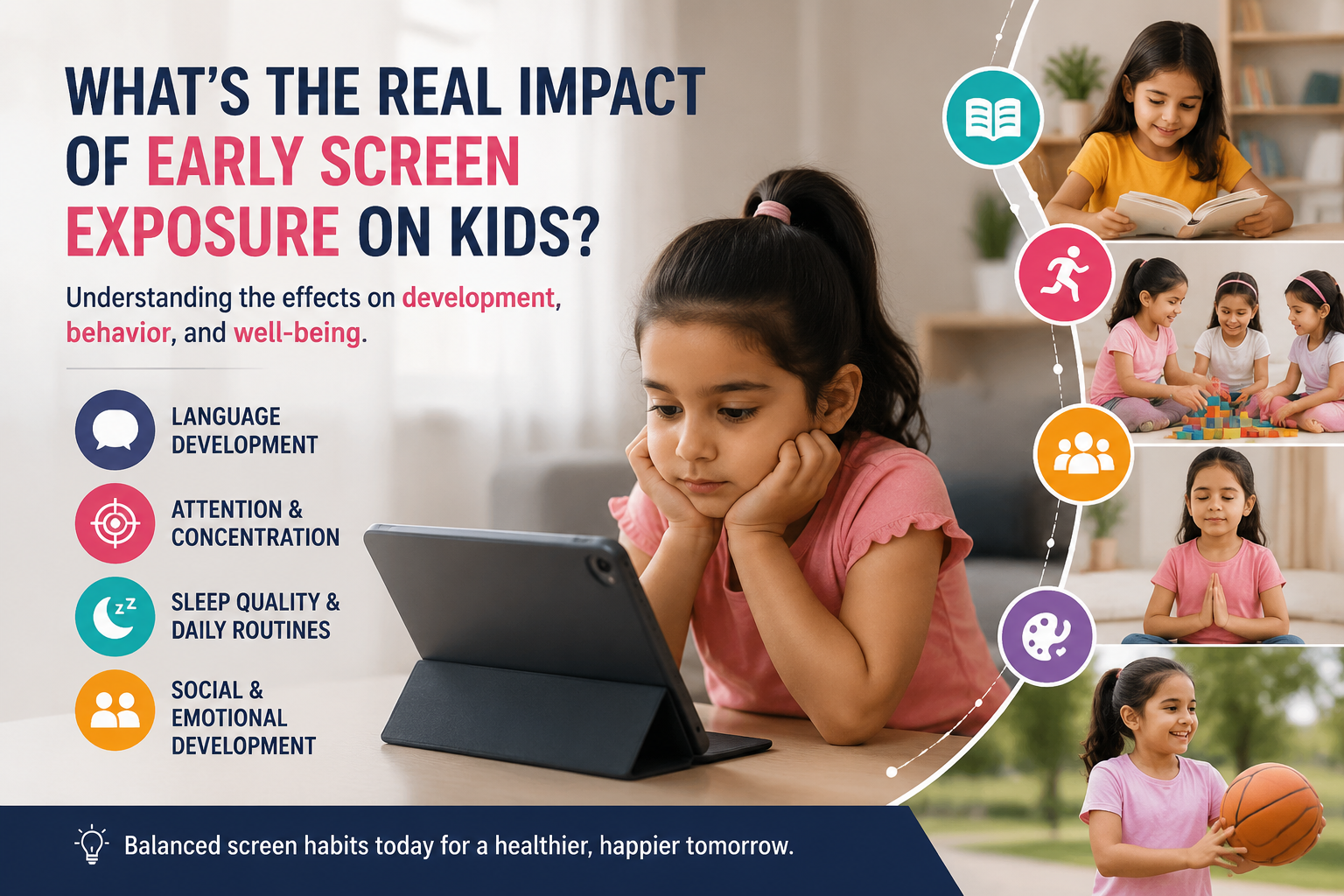
Children today are growing up in a world where screens are almost impossible to avoid. Since screens have become so interwoven into people’s daily routines, the question is no longer whether children will be exposed to them. The more important question is what early exposure may actually do to your child’s development. According to us at Queen’s Valley School, a leading all-girls CBSE school in Dwarka, early screen exposure can have a deep influence on how children communicate, play, focus, sleep, and engage with the world around them. As a school that believes in nurturing confident, well-rounded and emotionally aware young girls, we understand that healthy digital habits must begin early.
In this blog post, we have explained what early screen exposure can do to your kids. So ensure you read till the end.
Not Every Screen Exposure Has the Same Effect
Before you explore the potential impact of screen exposure on kids, we at Queen’s Valley School would want to first debunk one very common misunderstanding around the topic. We’re talking about the misconception that all screen use is damaging and similar. For example, a video call with grandparents is not the same as hours of passive screen time.
Hence, for parents, the real concern shouldn’t be about their kids being exposed to screens early in their lives. Instead, it should be about screens replacing activities that children usually do in their daily lives.
We’re talking about activities, such as talking with family members, playing with friends, moving around, exploring their surroundings, and interacting with people. At Queen’s Valley School, we strongly believe that children learn best when they are actively involved, whether through classroom discussions, creative activities, outdoor play, reading, sports, or meaningful peer interaction. With this distinction in mind, you should explore the impact of early screen exposure on kids.
Real Impact of Early Screen Exposure on Kids
Screen exposure doesn’t affect your kids in just one, pre-defined way. In fact, it impacts several key development areas. The following points will help you better understand the impact.
· Language Development
Young kids start developing their language skills as soon as they start interacting with their environment. When they start listening to what their parents are saying and observing their facial expressions, they begin their language development. Unfortunately, they cannot learn the same through passive screen viewing.
For example, if your toddler starts spending long hours watching content silently instead of talking to you or their friends, they’re unknowingly reducing their language development opportunities. They can only develop a strong vocabulary and social cues through real-world conversations. They teach children how communication works.
This is why schools and homes must encourage storytelling, reading habits, group conversations, recitation, role play and active listening from the early years. These practices support the kind of confident communication that Queen’s Valley School aims to build in every girl.
We’re not saying that occasional screen use can create a language problem, but you should be concerned if your child’s screen time consistently replaces their everyday, real-world interactions.
· Attention & Concentration
Early childhood is a period when children are still developing their attention skills. If they’re constantly exposed to rapidly changing visuals, fast editing, and highly stimulating content early in life, it may affect how they process information and sustain attention.
It doesn’t mean that a child who watches cartoons will automatically develop attention problems. It depends entirely on the duration, frequency, and quality of the content your kids are exposed to. You should help them maintain a healthy screen usage time so their attention and concentration aren’t severely affected. At Queen’s Valley School, structured classroom learning, hands-on activities, STREAM-based exposure, sports, arts and collaborative learning experiences help students strengthen focus in a more natural and balanced way. These real-world learning moments allow children to think, question, observe and participate instead of simply consuming information.
· Sleep Quality & Daily Routines
Sleep is an important part of healthy childhood development, as it supports the child’s learning, mood, memory, and overall growth. If your kids start using screens close to bedtime, it can start interfering with their sleep routine.
While many parents focus on the time their kids spend on screens, we firmly believe the timing of screen use is equally important. If screen use starts affecting your child’s sleep routine every day, its impact may extend far beyond bedtime and influence their energy levels, mood, and behaviour throughout the day. A well-rested child is more prepared to learn, participate, express herself and enjoy school life with confidence. This is why maintaining a healthy routine at home is just as important as creating a supportive learning environment at school.
· Social & Emotional Development
Children learn many social and emotional skills through everyday interactions with people around them. We’re talking about skills, such as learning how to share, waiting for their turn, handling frustration, understanding feelings, and maturely responding to different situations.
Your kids cannot learn these through instructions alone. Children usually develop them through repeated real-world experiences. If screens replace these experiences, your kids will get fewer opportunities to practice important social behaviours naturally. It can significantly limit their social and emotional development.
Frequently Asked Questions (FAQs)
· Is screen use harmful for kids?
It depends on the type of exposure. Uncontrolled, excessive screen use is definitely harmful to kids.
· How can parents reduce their kids’ screen dependence?
There are many ways. You can start by asking them to play outside in parks or read physical books. Engaging in family activities can also help reduce their screen dependence.
· At what age is it safe for kids to start using screens?
Kids who have begun their academic journey can start using screens, but only in controlled, supervised environments.
Conclusion
Kids growing up in today’s environment cannot avoid screen exposure at any stage of their lives. Whether for educational, entertainment, or social purposes, they will turn to screen use. As a parent, you cannot stop this exposure, but you can ensure it doesn’t hamper your child’s natural growth and development.
Here, we at Queen’s Valley School, a well-known girls’ school in New Delhi, would like to advise parents not to fear technology but instead guide children towards using it in a healthy and age-appropriate way. The goal is not to remove screens completely, but to ensure that screens do not replace conversation, curiosity, creativity, outdoor play, reading, emotional connection, and real-world learning. When children know and understand how to balance screen time with learning, physical activity, and social interaction, they are more likely to grow into confident, focused, and well-rounded individuals.