Why Modern Students Need More Than Just Textbooks?
posted on May 25, 2026
Discover why modern students need more than textbooks. Learn how critical thinking, problem-solving, collaboration, and technology enhance real-world learning.
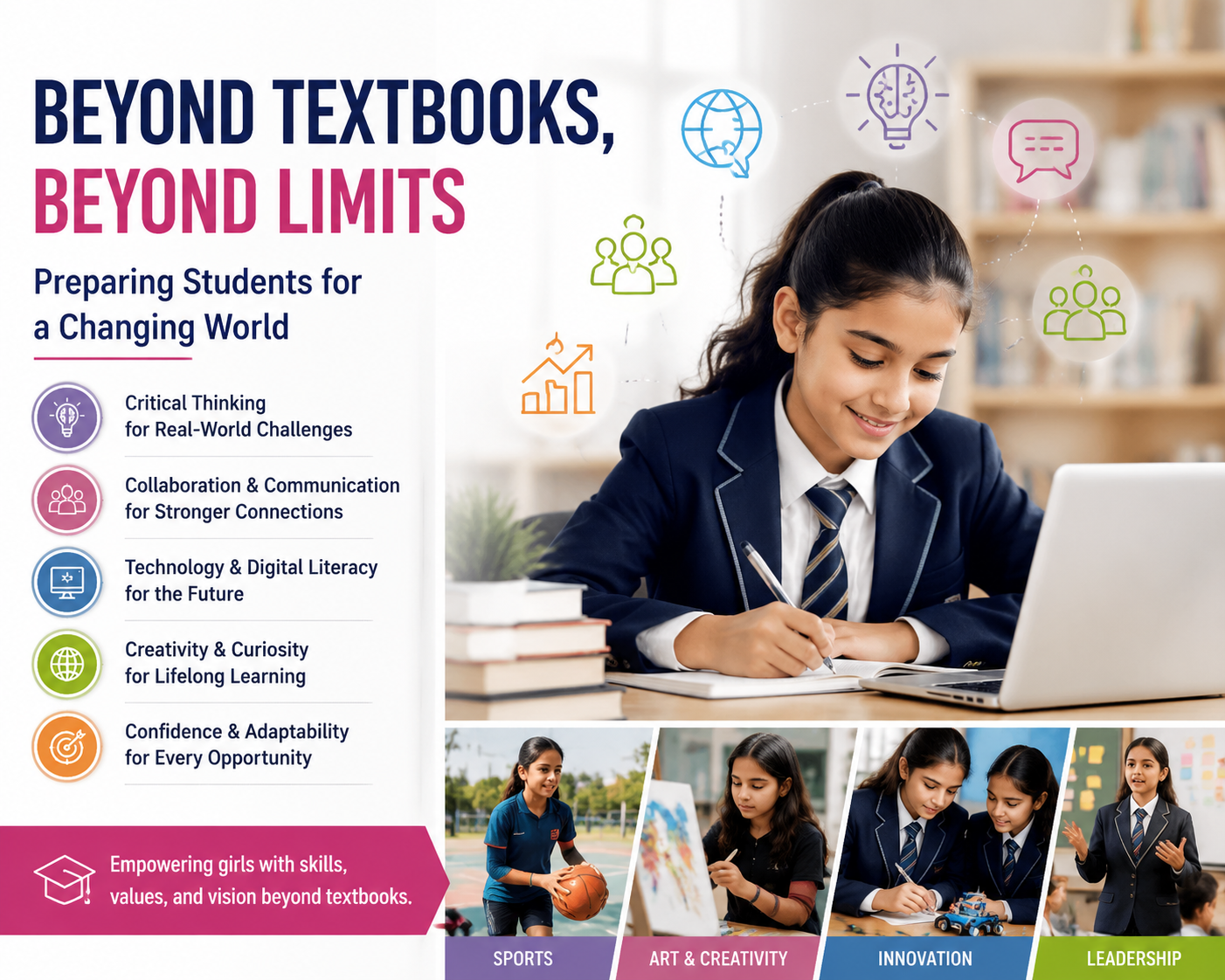
For decades, textbooks sat at the centre of education. Learning largely meant understanding what was written in them, remembering concepts, and demonstrating that knowledge in examinations. While textbooks continue to play an important role, the world students are preparing for has changed significantly. This clearly means that modern world students cannot rely solely on textbook knowledge to succeed in today’s environment.
If you’re wondering what more your children need to prepare for the modern world, you should read the full blog post.
Modern Students Should Expand Their Learning Beyond Textbooks
At Queen’s Valley School, recognised as a leading all-girls CBSE school in Dwarka, Delhi we believe every student needs broader learning. While strong academic foundations still matter, they cannot be based on textbook learning alone.
Hence, besides having an understanding of the concepts written in books, it is important that modern students also possess skills like thinking creatively, communicating effectively, using technology responsibly, working with others like a team, and responding to change with confidence.
Essentially, the goal here should be to move beyond merely acquiring bookish information and instead, acquire the skills to understand, apply, and use the knowledge meaningfully in different situations.
Why Modern Students Need More Than Just Textbooks?
Now that you’ve understood what exactly modern students need beyond textbook learning, let’s explore why they need it.
- Textbooks Help Build One’s Knowledge Bank, But Real Learning Requires Application
Textbooks are designed to provide structured learning. They introduce students to theories, concepts, and principles in an organised way, helping students build a strong understanding of subjects.
However, this knowledge becomes valuable only when students can connect it to real-world situations. For example, reading about environmental sustainability and understanding its definitions is one level of learning. But seeing for oneself how waste is managed in a local community is another level of learning. This is where learning actually becomes useful.
Application adds context and helps students understand not only ‘what’ something is, but also ‘why’ it matters and ‘how’ it works in real situations.
- Information is Everywhere, Judgment is Rare
Not very long ago, finding information itself required a lot of effort. But today, any kind of information can be accessed very easily and in an instant through search engines, videos, online communities, AI tools, and social platforms. All thanks to the internet, access to information is no longer a challenge.
Having said that, the real issue now is identifying what can be trusted and what cannot. The problem is that all the information on the internet appears so polished and convincing, even when it lacks accuracy or context. Hence, it is important that students develop the ability to ask important questions, such as –
- Is this source reliable?
- Is something missing?
- Does the claim have reliable evidence supporting it?
We’re living in an environment where information moves faster than ever. So, learning how to think critically has become just as important as textbook learning.
At Queen’s Valley School, we encourage our students to conduct independent research, projects, and other activities that constantly require them to use their critical thinking, problem-solving, and analytical skills. It’s the most practical way to help them develop sharp judgment ability.
- Career Expectations Have Expanded Beyond Academic Scores
Academic performance still holds significant value, but it cannot secure good career opportunities on its own. Employers are now choosing to hire individuals who offer more than core subject knowledge and skills. They now prioritise individuals who can –
- Collaborate with team members
- Communicate clearly
- Solve problems
- Adapt to changing situations
- Exhibit leadership qualities
Unfortunately, textbook learning alone cannot help students develop and hone these abilities. It’s a key reason why we at Queen’s Valley School, a highly regarded CBSE school in Dwarka, use a healthy mix of activities to instil and sharpen these skills in our students.
From sports and artistic activities to group project participation and school event organisation, our students participate in all of these to develop the key skills that top employers prefer.
- Technology Has Changed the Learning Experience Itself
Learning is no longer limited to textbooks. Students now have easy and continuous access to a wide range of interactive learning tools. From simulations and virtual learning environments to educational platforms and AI-supported assistance, they can use multiple options to understand concepts clearly and deeply.
However, it does not mean technology should replace traditional learning. It will merely strengthen understanding by making difficult concepts easier to visualise and explore.
For instance, we at Queen’s Valley School, have installed smart boards supported by the latest technology across classrooms. The software we use for e-teaching is specifically designed to align with the requirements of the CBSE curriculum. The technology we are using is not intended to replace traditional forms of learning but is merely an effort to support and make learning more effective for our students.
- Textbooks Don’t Prepare Students to Handle Uncertain Problems
All textbooks generally focus on already established knowledge and structured answers. However, real-life situations don’t always present clear instructions or single solutions. Many problems require constant experimentation, different perspectives, and original thinking.
If students rely entirely on textbook learning, they may struggle when exposed to real-world situations. Students can tackle such scenarios with a creative and curious mind. It will usually push students to move beyond accepting information at face value and explore deeper questions.
Frequently Asked Questions (FAQs)
- Are textbooks no longer important for modern students?
Textbooks are still important for modern students. It’s just that textbooks alone are no longer enough. To compete and thrive in the modern world, students need to explore more learning media and activities that can help broaden their learning.
- What skills are becoming important for modern students?
Critical thinking, problem-solving, communication, and collaboration are some of the key skills that have become extremely important for modern students.
- Can technology replace traditional learning?
No. Technology is only intended to support and improve existing learning experiences.
Conclusion
Textbooks have always been an important part of academic learning, and they still command the same value. However, they’re no longer considered sufficient on their own when it comes to modern students’ holistic learning and growth.
Students today must move beyond textbooks and engage with different media that allow them to approach learning in different ways. We at Queen’s Valley School, a well-known CBSE school in New Delhi, have been doing it ever since the inception of our campus, and we’ve seen incredible growth in our students.