The Four Pillars of Education
posted on Jun 03, 2026
As a parent, you should enrol your child in a school that upholds all four pillars in a structured, guided, and transformative way.
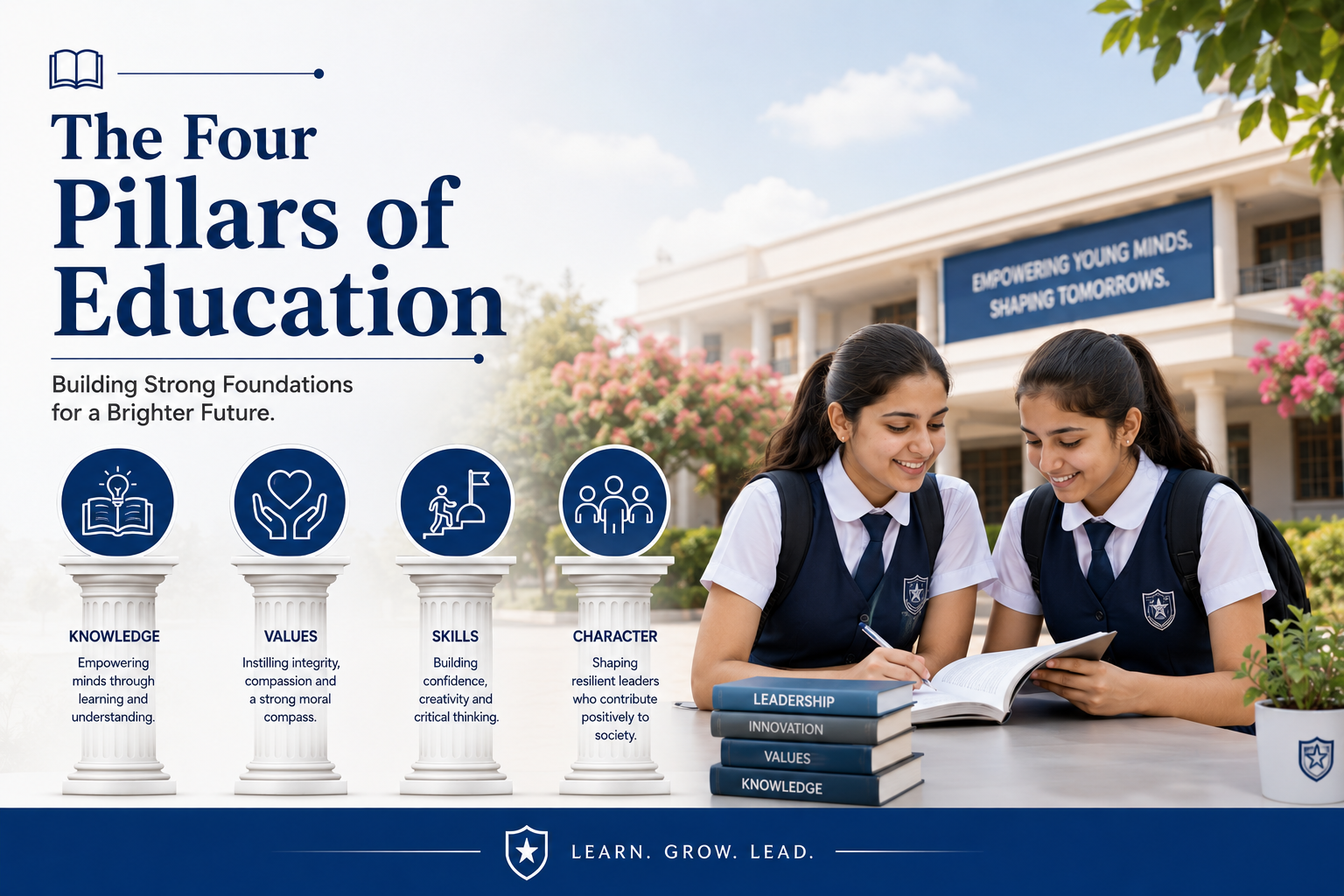
People have started to develop a very narrow view of a child’s educational journey. It’s being largely linked to marks, examinations, and academic achievements. While they all hold importance, we at Queen’s Valley School, positioned among the top 10 schools in Dwarka, Delhi, believe they shouldn’t define a child’s entire learning journey.
After all, the real purpose of education was meant to be much broader, but it was unfortunately lost over the decades. Hence, UNESCO introduced the concept of the four pillars of education to realign children with the right educational path. This approach is aimed at preparing children not only for higher studies and careers, but also for life.
In case you haven’t heard about it before and are unsure about its relevance in your child’s education journey, this blog post will give you complete clarity on the same. Read till the end.
The Four Pillars of Education: Getting Started with the Basics
UNESCO introduced the four pillars of education to redefine the purpose of education in today’s rapidly evolving world. Instead of focusing only on academics, this framework emphasises developing the whole child. It’s similar to Queen’s Valley School’s vision of making every girl child ‘सर्वगुणसम्पन्न’ by focusing on their 360-degree growth.
This framework comprises the following four pillars:
- Learning to Know
- Learning to Do
- Learning to Live Together
- Learning to Be
Each of these four pillars might look isolated, but they actually work together. They balance growth across intellectual, practical, social, and personal dimensions.
Diving Deeper into the Four Pillars of Education
Simply knowing about each pillar isn’t sufficient. You should also know what each means in your child’s education journey. Let’s explore it now.
-
Learning to Know: Developing Curiosity & Understanding
It’s the pillar most parents are already familiar with. It focuses on acquiring knowledge, understanding concepts, and developing the ability to think critically. However, its goal extends far beyond memorising facts. According to this pillar, true learning happens when children become curious, ask questions, explore ideas, and learn how to learn independently.
A student who develops this pillar doesn’t simply absorb information. They master the art of independent learning and can learn any new skill whenever their life demands. Being one of the top 10 schools in Dwarka, we at Queen’s Valley School uphold this pillar by guiding our students to pursue inquiry-based exploration, individualised learning, and research-oriented learning experiences across different stages of their education.
-
Learning to Do: Turning Knowledge into Action
A child may theoretically understand a scientific concept, but can they apply it in a real-world setting to solve problems? This is the central idea behind this pillar. It focuses on practical application, encouraging students to develop problem-solving abilities, creativity, collaboration, etc., and other capabilities that can help them put knowledge into action.
We believe hands-on experiences play a critical role in developing this pillar. Hence, we at Queen’s Valley School, a well-known all-girls school, support this pillar by providing our students with ample opportunities for experiential learning. Our students enjoy diverse, hands-on learning experiences in STEAM, Robotics, Astronomy, and more. It gives them the clarity, confidence, and subject-matter expertise needed to translate their theoretical know-how into practical action.
-
Learning to Live Together: Preparing Children for an Interconnected World
Academic excellence alone doesn’t guarantee success in life. If you want to see your kids succeed in all areas of their lives, you must teach them how to collaborate, communicate, respect differences, and contribute positively to society. It is precisely what this pillar encompasses.
The ‘Learning to Live Together’ pillar focuses on developing key skills that a child needs to maintain harmonious connections and collaborations. It also teaches students that they’re part of a larger community and that understanding different perspectives is essential in an increasingly interconnected world.
This pillar becomes particularly important today, as children are expected to interact with peers from diverse backgrounds and viewpoints.
-
Learning to Be: Helping Children Discover Their Full Potential
This one is the most transformative pillar, as it focuses on the development of the whole child, not just as a student but as an individual. This pillar encompasses some of the most crucial aspects, including self-awareness, emotional intelligence, resilience, confidence, ethics, creativity, etc. At its core, the pillar asks a simple question: Who is this child becoming?
As we at Queen’s Valley School have all female students, we give special emphasis to this aspect. We strongly believe every girl child should be provided with appropriate opportunities to enable them to discover their strengths, develop confidence, overcome challenges, and build a sense of purpose.
Although different schools adopt different approaches to upholding this pillar, we usually use a combination of sports, clubs, leadership opportunities, and wellness initiatives to better support our students.
Frequently Asked Questions (FAQs)
-
What are the four pillars of education?
Learning to Know and Learning to Do are the two key pillars. Learning to Live Together and Learning to Be are the other key pillars.
-
Who introduced the four pillars of education framework?
UNESCO first introduced the concept of the four pillars of education, which was later tweaked slightly by individual schools before being fully integrated into their curricula.
-
Are the four pillars of education relevant in today’s world?
Yes. In fact, they’re more relevant today than they’ve ever been.
-
How can parents support the four pillars of education?
As a parent, you should enrol your child in a school that upholds all four pillars in a structured, guided, and transformative way.
Conclusion
Some people are making education restrictive by nature by associating it entirely with marks and other traditional academic achievements. Yes, marks and academic achievements still have their rightful place in a child’s education journey, but they shouldn’t become the only thing that matters. UNESCO’s Four Pillars of Education framework was introduced to address this challenge.
We at Queen’s Valley School, one of the best CBSE girls school in Delhi, highly trusted for its specially curated environment for girls, firmly believe that every girl child deserves to grow holistically and develop all the skills, mindset, and behaviours needed to thrive in even the most competitive environments. Hence, we have been diligently following all four pillars since our inception. They’re an inseparable part of our curricula and pedagogy, and this is one of the key reasons why our students usually perform incredibly well on all fronts, not just academically.